
- ATLAS OF WOODS
- Species Data Sheet
- ORIGIN: Amazon
Andiroba
- Carapa guianensis
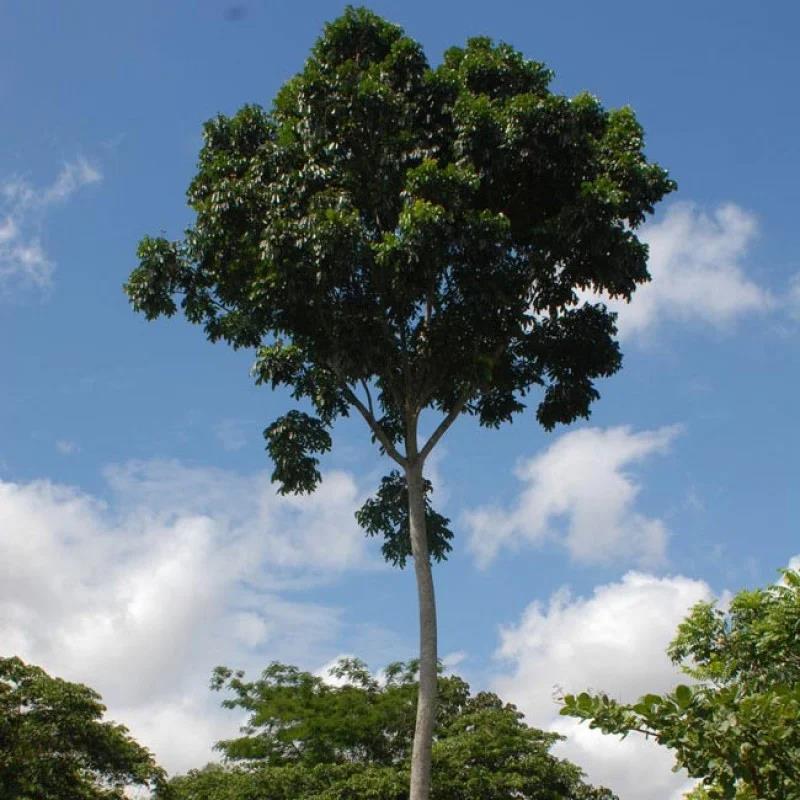
Andiroba is a tree species native to the Amazon, known both for the value of its wood and for the oil extracted from its seeds, widely used in traditional medicine.
Family
Meliaceae
Color
Light brown to reddish brown
Density
0.55 to 0.70 g/cm³
Uses
Furniture and general woodworking, light and medium construction, plywood and laminates, crates and window and door frames, and rural carpentry.
Grain
Usually straight
Conservation Passport
- IUCN
- Least Concern (LC) · assessed in 2017
- CITES
- Not listed
- BRAZILIAN RED LIST
- Not on the official list
- LEGISLATION
- Not on the official list of threatened species: harvesting of native trees only under an approved PMFS (sustainable forest management plan) or a clearing permit from the environmental agency, and transport with a DOF (Sinaflor).

About the species
Andiroba is a tree of great ecological, social and economic value that can be managed sustainably, without felling, simply by collecting its seeds.
The traditional Amazonian use of andiroba is widespread, and there is promising scientific evidence of its anti-inflammatory, wound-healing and repellent properties. However, it does not replace medical treatment for more serious conditions.
- Common names
Historical and cultural significance
– Andiroba is traditionally used by Amazonian communities, especially for the oil from its seeds, used as a repellent and in medicinal practices.
– The oil was also widely used for lighting, cosmetics and folk medicine.
– Culturally, the species is considered one of the most important medicinal trees of the Amazon rainforest.
Botanical classification
- DOMAIN
- Eukaryota
- KINGDOM
- Plantae
- DIVISION
- Magnoliophyta
- CLASS
- Magnoliopsida
- ORDER
- Sapindales
- FAMILY
- Meliaceae
- GENUS
- Carapa
- SPECIES
- Carapa guianensis
Natural distribution

- States of occurrence
- Ecology and habitat
– Habitat: humid tropical forests, várzea (floodplain) areas, riverbanks and periodically flooded soils.
– Countries and regions: Brazil — Brazilian Amazon (main occurrence) / the Guianas / Venezuela / Colombia / Peru / Bolivia / Central America and the Caribbean (some populations)
Tree morphology
- SIZE
- Medium to large tree, able to reach 20 to 30 meters in height.
- TRUNK
- Straight, cylindrical, with a long, clean bole.
- BARK
- Grayish brown, relatively smooth to slightly fissured.
- CROWN
- Tall, rounded and dense.
- DBH
- May exceed 1 m.
- LEAVES
- Compound, pinnate, with leathery dark green leaflets.
- FRUIT
-
Globose woody capsule that opens naturally.
Seeds: Large, oil-rich (the source of andiroba oil).
Maturity and harvest
- Timeline · from seed to senescence
Economic harvest · 25 to 40 years
average economic harvest age, which may vary with environmental conditions
Full maturity · Over 30 years
full maturity of the wood occurs at older ages, generally over 30 years
– Andiroba growth is moderate.
– The species allows sustainable harvesting that combines timber production with oil extraction.
Wood characteristics
- HEARTWOOD
- Light brown to reddish brown.
- SAPWOOD
- Light yellow to light beige.
- TEXTURE
- Medium.
- GRAIN
- Usually straight.
- Working properties
– Density: Medium (0.55 to 0.70 g/cm³).
– Natural durability: Moderate to good.
– Stability: Good.
– Workability: Easy to moderate, with good finishing.
– Hardness: Medium.
– A wood considered versatile and of good quality for general uses.
Wood uses
- Uses of the tree
– Reforestation and recovery of degraded areas
– An important species for agroforestry systems
– Andiroba oil (main economic use): Folk medicine (traditional use as an anti-inflammatory, wound-healing agent and antiseptic); Natural insect repellent; Cosmetics and soaps; Traditional veterinary use.
Conservation and legislation
– Harvesting is regulated by sustainable forest management plans and Brazilian environmental legislation (IBAMA and state agencies).
– In many regions, community management is encouraged to produce oil without felling the tree.
Additional information
– A species tolerant of wet soils and seasonally flooded areas.
– Important for wildlife, especially rodents that help disperse the seeds.
– Because it can be managed sustainably, without felling, simply by collecting the seeds, it has great ecological, social and economic value in the Amazon.