
- ATLAS OF WOODS
- Species Data Sheet
- ORIGIN: Atlantic Forest
Guapuruvu
- Schizolobium parahyba
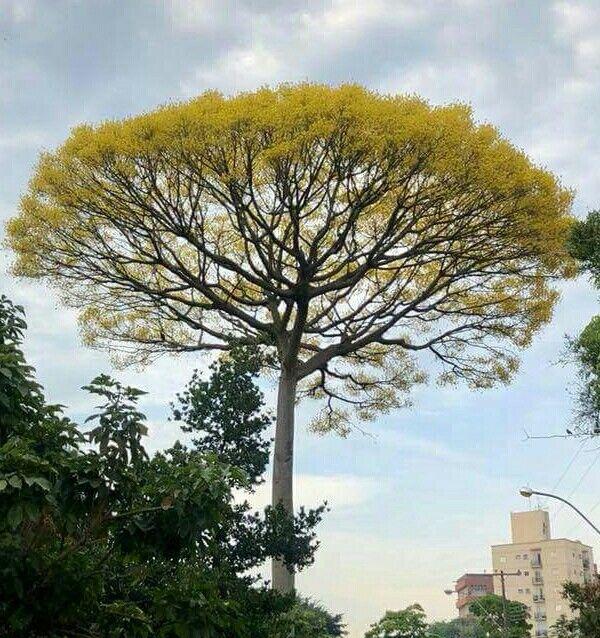
Guapuruvu is a tree native to the Atlantic Forest, known for its extremely fast growth and large size. It has various applications in light carpentry, plywood and packaging, as well as great ecological importance, and is widely used in reforestation and environmental restoration.
Family
Fabaceae
Color
Yellowish white to pale yellow
Density
0.30 to 0.45 g/cm³
Uses
Plywood, boxes and packaging, light carpentry, simple furniture, canoes and light boats and pulp production.
Grain
Generally straight
Conservation Passport
- CITES
- Not listed
- BRAZILIAN RED LIST
- Not on the official list
- LEGISLATION
- Not on the official list: plantations of native species are exempt from cutting authorization but must be reported to the environmental agency, and transport requires a DOF; harvesting of native trees follows a PMFS or authorization.

About the species
Guapuruvu (Schizolobium parahyba) is a tree native to South America, belonging to the family Fabaceae (subfamily Caesalpinioideae).
Typical of the Atlantic Forest, it occurs naturally along an extensive stretch of Brazil’s coast and interior, mainly in the Southeast and South, and also in part of the Northeast.
It is a fast-growing species that can reach great heights in just a few years.
It stands out for its high crown, straight trunk and showy yellow flowers, and is widely used in reforestation and landscaping.
The family Fabaceae includes many economically important species, such as timber trees, food plants and species used in reforestation.
The species has several common names in different regions of Brazil. The name guapuruvu is of Indigenous origin, derived from the Tupi language.
- Common names
Historical and cultural significance
– Guapuruvu has historical and cultural importance in several regions of Brazil.
– Traditionally, it was used to build light canoes, make rural utensils, produce handcrafted boats and make boxes and packaging.
– Today, it is also valued in urban landscaping for its showy flowers and fast growth.
– The species also has great ecological importance in environmental restoration projects.
Botanical classification
- DOMAIN
- Eukaryota
- KINGDOM
- Plantae
- DIVISION
- Magnoliophyta
- CLASS
- Magnoliopsida
- ORDER
- Fabales
- FAMILY
- Fabaceae
- GENUS
- Schizolobium
- SPECIES
- Schizolobium parahyba
Natural distribution

- States of occurrence
- Ecology and habitat
– It grows in secondary forests, forest edges, humid slopes and regenerating areas.
– Countries of occurrence: Brazil / Paraguay / Argentina / Bolivia
Tree morphology
- SIZE
- Guapuruvu is a large tree, reaching 20 to 35 m in height.
- TRUNK
- Straight and cylindrical, with a diameter of 60 to 100 cm.
- BARK
- Grayish and relatively smooth.
- LEAVES
- Bipinnately compound, large, and may exceed 1 m in length.
- FRUIT
-
Woody pods containing flattened seeds.
Flowers: Yellow and showy, in large inflorescences.
Maturity and harvest
- Timeline · from seed to senescence
Economic harvest · 10 to 18 years
economic harvest age
Full maturity · 18 to 30 years
peak wood quality
– Guapuruvu grows extremely fast.
– Forest management generally uses a minimum cutting diameter of around 40 cm DBH.
Wood characteristics
- HEARTWOOD
- Yellowish white to pale yellow.
- SAPWOOD
- Creamy white to light yellow, not clearly distinct from the heartwood.
- TEXTURE
- Medium to coarse.
- GRAIN
- Generally straight.
- Working properties
– Workability: very easy machining.
– Natural durability: low.
– Density: Very light to light wood (0.30 to 0.45 g/cm³).
– Classification: It is classified as a common wood due to its low density, low mechanical strength and lower commercial value compared with noble woods.
Wood uses
- Uses of the tree
– Reforestation
– Restoration of degraded areas
– Urban tree planting and landscaping
Conservation and legislation
Additional information
– Guapuruvu is of great ecological importance, being a pioneer species in the regeneration of degraded areas.
– It grows fast in open areas.
– Its flowers attract bees and other pollinators, contributing to biodiversity.