
- ATLAS OF WOODS
- Species Data Sheet
- ORIGIN: Amazon
Paricá
- Schizolobium amazonicum
Paricá is a tree native to the Amazon, widely used in the timber industry because of its fast growth and its light, excellent-quality wood. It stands out as one of the main species for producing veneers, plywood and panels in Brazil.

Family
Fabaceae
Color
Light to yellowish, ranging from creamy white to pale yellow
Density
0.30 to 0.40 g/cm³
Uses
Plywood, veneers, panels, light furniture and crates.
Grain
Usually straight
Conservation Passport
- CITES
- Not listed
- BRAZILIAN RED LIST
- Not on the official list
- LEGISLATION
- Not on the official list: plantations of native species do not require a cutting authorization but must be reported to the environmental agency, and transport requires a DOF; harvesting of native trees follows a PMFS or authorization.

About the species
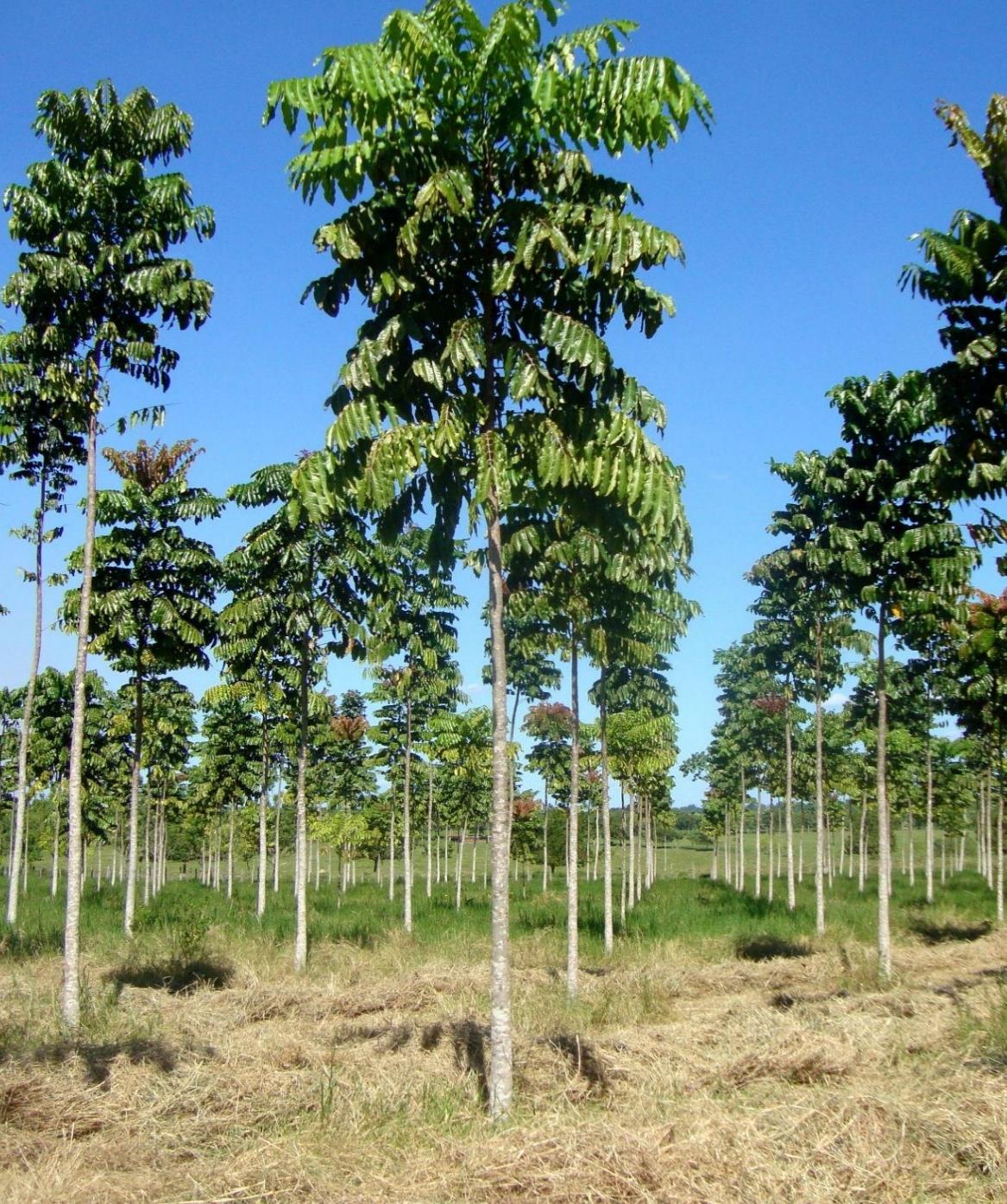
Paricá (Schizolobium amazonicum) is a tree species native to the Amazon region, belonging to the Fabaceae family.
It stands out for its fast growth and its use in commercial plantations for timber production.
One of the most widely planted forest species in Brazil’s North region.
It is also known as guapuruvu-da-amazônia.
The genus Schizolobium includes fast-growing tropical trees widely used in silviculture.
The species has several common names in different regions. These names reflect regional characteristics and its resemblance to other trees of the same botanical group.
- Common names
Historical and cultural significance
– Paricá has great economic importance in Brazil, especially in the Amazon region.
– Its wood is widely used in industry for the production of plywood, veneers and wood panels.
– Pará and Maranhão have large areas planted with paricá.
– Today, it is one of the main species grown in commercial plantations to supply the timber industry.
Botanical classification
- DOMAIN
- Eukaryota
- KINGDOM
- Plantae
- DIVISION
- Magnoliophyta
- CLASS
- Magnoliopsida
- ORDER
- Fabales
- FAMILY
- Fabaceae
- GENUS
- Schizolobium
- SPECIES
- Schizolobium amazonicum
Natural distribution

- States of occurrence
- Ecology and habitat
– It grows well in hot, humid regions and forests, open areas, well-drained soils and regenerating areas.
– Countries of occurrence (South America): Brazil / Peru / Colombia / Bolivia
Tree morphology
- SIZE
- Medium to large size, between 20 and 40 m tall.
- TRUNK
- Straight and cylindrical.
- BARK
- Light-colored and relatively smooth.
- CROWN
- High and sparse.
- DBH
- 50 to 80 cm.
- LEAVES
- Bipinnately compound.
- FRUIT
- Pods containing seeds.
Maturity and harvest
- Timeline · from seed to senescence
Economic harvest · 7 to 12 years
economic harvest age
Full maturity · 12 to 18 years
peak wood quality
– Paricá grows fast.
– In commercial plantations, it quickly reaches dimensions suitable for harvesting.
– These characteristics make paricá one of the best-suited species for short-rotation tropical silviculture.
Wood characteristics
- HEARTWOOD
- Light to yellowish, ranging from creamy white to pale yellow.
- SAPWOOD
- Yellowish white to light cream.
- TEXTURE
- Medium.
- GRAIN
- Usually straight.
- Working properties
– Workability: excellent.
– Natural durability: low — susceptible to termites and fungi if not properly treated.
– Drying: with a low incidence of defects.
– Suitability for veneering: good.
– Density: Low (0.30 to 0.40 g/cm³).
– Classification: It is classified as a semi-noble wood due to its wide industrial use, despite its low natural durability; In some markets, paricá wood is classified as a common wood, depending on its end use.
Wood uses
- Uses of the tree
– Commercial plantations
– Reforestation
– Shade in agroforestry systems
– Restoration of degraded areas
Conservation and legislation
Additional information
– Paricá is one of the most widely planted forest species in Brazil’s North region.
– About 90,000 hectares have already been planted, led by Pará, which accounts for more than 85% of national production.
– It is one of the main species used in Brazil’s plywood industry.
– The species stands out for its fast growth, high productivity in commercial plantations and excellent workability. Its fast growth makes it useful in CO₂ sequestration projects.
– Because it is vulnerable to termites, fungi and moisture, it is a wood of low durability unless properly treated.
– Despite its low natural durability, it has great economic importance due to its scale of production.
– Exports of paricá-based plywood are significant, especially to Asian markets, the US and Europe.