
- ATLAS OF WOODS
- Species Data Sheet
- ORIGIN: Cerrado · Atlantic Forest
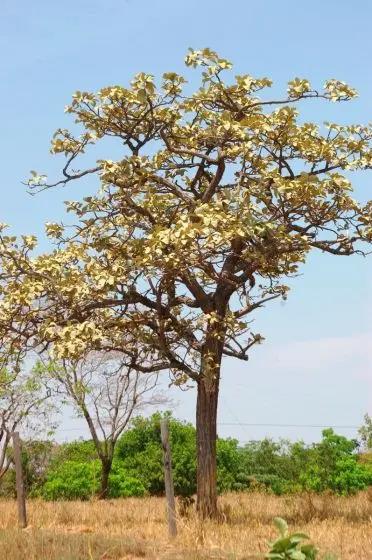
Peroba-mica
- Aspidosperma macrocarpon
Peroba-mica is a Brazilian forest species of great timber value, recognized for the strength, durability and beauty of its wood. It is widely used in building construction and joinery, and also has significant economic importance.
Family
Apocynaceae
Color
Yellowish brown to pinkish brown, which may turn reddish brown
Figure
Shiny glints in the fibers reminiscent of mica
Density
0.75 to 0.95 g/cm³
Uses
Building construction, beams and rafters, furniture, flooring, window and door frames, and general joinery.
Grain
Usually straight
Conservation Passport
- CITES
- Not listed
- BRAZILIAN RED LIST
- Not on the official list
- LEGISLATION
- Not on the official list of threatened species: harvesting of native trees only with an approved PMFS or a clearing authorization from the environmental agency, and transport with a DOF (Sinaflor).

About the species
Peroba-mica (Aspidosperma macrocarpon) is a tree species native to Brazil, belonging to the Apocynaceae family, and important for forest conservation and restoration.
Peroba-mica stands out for the excellent quality of its wood and its high commercial value, and is widely used in structural applications.
According to some sources, the name “peroba-mica” comes from combining two references to the appearance of this tree’s wood: “peroba” is a term of Tupi origin used in Brazil for various hardwood trees, which over time became associated with high-strength woods; “mica” refers to the mineral mica, known for forming shiny, glittering sheets.
The name “peroba-mica” comes from the fact that the cut hardwood shows shiny glints in the fibers reminiscent of mica.
The Apocynaceae family includes several tropical species that produce wood and medicinal compounds.
The species has several common names in Brazil. These names relate to the appearance of the wood and to its natural occurrence.
- Common names
Historical and cultural significance
– Peroba-mica has great economic importance in Brazil.
– Traditionally, its wood is used in building construction, rural structures and furniture making.
– Because of its strength, it has always been widely used in structural applications.
– It has a historical presence in rural buildings of Brazil’s interior.
Botanical classification
- DOMAIN
- Eukaryota
- KINGDOM
- Plantae
- DIVISION
- Magnoliophyta
- CLASS
- Magnoliopsida
- ORDER
- Gentianales
- FAMILY
- Apocynaceae
- GENUS
- Aspidosperma
- SPECIES
- Aspidosperma macrocarpon
Natural distribution

- States of occurrence
- Ecology and habitat
– It prefers well-drained soils, tropical or subtropical climates, and cerrado areas and open forests.
– Countries of occurrence (South America): Brazil / Bolivia / Paraguay
– Biomes in Brazil: Cerrado / Atlantic Forest
– Vegetation types: Semideciduous seasonal forests
Tree morphology
- SIZE
- Medium to large size, between 20 and 35 m tall.
- TRUNK
- Straight and cylindrical.
- BARK
- Thick and fissured.
- CROWN
- Relatively dense.
- DBH
- 50 to 80 cm.
- LEAVES
- Simple.
- FRUIT
- Capsules containing winged seeds.
Maturity and harvest
- Timeline · from seed to senescence
Economic harvest · 40 to 60 years
economic harvest age
Full maturity · 45 to 70 years
peak quality
– Peroba-mica grows at a moderate rate.
– Forest management sets large cutting diameters, usually above 50 cm DBH.
– Average diameter growth: Approximately 0.5 to 0.8 cm per year.
Wood characteristics
- HEARTWOOD
- Yellowish brown to pinkish brown, which may turn reddish brown.
- SAPWOOD
- Yellowish white to light cream.
- TEXTURE
- Medium.
- GRAIN
- Usually straight.
- Working properties
– Workability: moderate.
– Mechanical strength: good.
– Dimensional stability: good.
– Natural durability: high.
– Density: High, a heavy wood (0.75 to 0.95 g/cm³).
– Classification: It is classified as a semi-noble wood due to its good strength and durability, and is widely used in structural applications.
Wood uses
- Uses of the tree
– Reforestation
– Restoration of degraded areas
– Rural tree planting
Conservation and legislation
– Its harvesting must follow Brazilian environmental law, sustainable forest management plans and regional harvesting controls.
– Harvesting of species of the genus Aspidosperma has been affected in some regions by extensive logging.
Additional information
– Peroba-mica has great economic importance in Brazil.
– It stands out for its good mechanical strength, high natural durability, versatility of use and the excellent quality of its wood, with high commercial value.
– An important native species for forest conservation and restoration.
– The species has potential for silviculture and sustainable management, especially in cerrado regions.
– Widely used in structural applications and building construction.