
- ATLAS OF WOODS
- Species Data Sheet
- ORIGIN: Atlantic Forest
Caxeta
- Tabebuia cassinoides
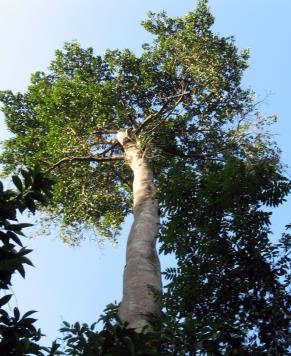
Caxeta is a tree native to Brazil, belonging to the family Bignoniaceae. It occurs mainly in flooded areas of the Atlantic Forest, especially along the coast of Southeast and South Brazil. Its wood is extremely light, uniform and exceptionally workable, and has traditionally been used to make pencils, clogs, handicrafts, floats, toys and turned pieces.
Family
Bignoniaceae
Color
Creamy white to yellowish white
Density
0.25 to 0.40 g/cm³
Uses
Handicrafts, sculptures, toys, pencils, clogs, light boxes, models and prototypes and simple musical instruments.
Grain
Generally straight
Conservation Passport
- CITES
- Appendix II
- BRAZILIAN RED LIST
- Vulnerable (VU)
- LEGISLATION
- Threatened species (VU) on the official list: cutting, transport and trade of native trees prohibited, except for licensed plantations or expressly regulated management; as it is listed in CITES App. II, timber exports require a CITES permit.

About the species
Caxeta (Tabebuia cassinoides) is a tree native to Brazil, belonging to the family Bignoniaceae.
It is characteristic of wet and flooded environments and is known for its extremely light, soft wood, suited to craft and industrial uses.
Because it occurs in swampy ecosystems and restingas, its harvesting must be carried out under strict sustainable management and in compliance with environmental law.
The family Bignoniaceae includes several tropical tree species known for their ornamental flowers and ecological importance.
The species goes by different common names in various regions of Brazil. These names are generally related to the lightness of the wood and its traditional use in making boxes and light utensils.
- Common names
Historical and cultural significance
– Caxeta has great cultural importance, especially in artisan communities on the Brazilian coast, above all in the Vale do Ribeira, where it was widely used to make clogs, toys and decorative objects.
– Historically, its wood was used to produce clogs, handmade toys, decorative objects, sculptures in light wood, and pencils and household utensils.
– In Ilhabela and other areas of the São Paulo coast, caxeta became a tradition in handicraft production, representing an important cultural and economic activity.
Botanical classification
- DOMAIN
- Eukaryota
- KINGDOM
- Plantae
- DIVISION
- Magnoliophyta
- CLASS
- Magnoliopsida
- ORDER
- Lamiales
- FAMILY
- Bignoniaceae
- GENUS
- Tabebuia
- SPECIES
- Tabebuia cassinoides
Natural distribution

- States of occurrence
- Ecology and habitat
– Found in the Brazilian Atlantic Forest, mainly in coastal areas.
– Swamps and flooded areas, riparian forests and restinga forests.
– A species adapted to permanently wet or waterlogged soils.
– Countries of occurrence: Brazil / Argentina (Misiones province)
Tree morphology
- SIZE
- Caxeta trees are medium in size, reaching 10 to 20 m in height.
- TRUNK
- Straight and cylindrical, with a diameter of 30 to 50 cm.
- BARK
- Pale, smooth when young and slightly fissured in mature trees.
- LEAVES
- Simple, opposite, oval in shape with entire margins.
- FRUIT
- Elongated capsules with winged seeds dispersed by the wind.
Maturity and harvest
- Timeline · from seed to senescence
Economic harvest · 12 to 20 years
economic harvest age
Full maturity · 20 to 30 years
peak wood quality
– Caxeta grows relatively fast, especially in wet environments.
– Forest management generally uses a minimum cutting diameter of 30 to 40 cm DBH.
Wood characteristics
- HEARTWOOD
- Creamy white to yellowish white.
- SAPWOOD
- White to light cream, practically indistinguishable from the heartwood.
- TEXTURE
- Fine and uniform.
- GRAIN
- Generally straight.
- Working properties
– Workability: excellent, easy to cut and carve.
– Drying: fast.
– Natural durability: low.
– Density: Very light (0.25 to 0.40 g/cm³).
– Classification: It is considered one of the lightest woods in Brazil. It is classified as a common wood due to its low density, low natural durability and lower commercial value compared with noble woods, but in some markets it is semi-noble.
Wood uses
- Uses of the tree
– Ecological restoration projects
– Restoration of flooded areas
– Tree planting in wet areas
Conservation and legislation
– Today, its harvesting requires environmental authorization.
– In many areas, extraction is regulated by forest management plans.
– These measures aim to ensure the sustainable use of the species.