
- ATLAS OF WOODS
- Species Data Sheet
- ORIGIN: Practically all biomes
Embaúba
- Cecropia pachystachya
Embaúba is a pioneer tree widely distributed across tropical America and very common in areas of forest regeneration. Its light wood has various uses in simple carpentry and handicrafts, but it has low density and low natural durability.
Family
Urticaceae
Color
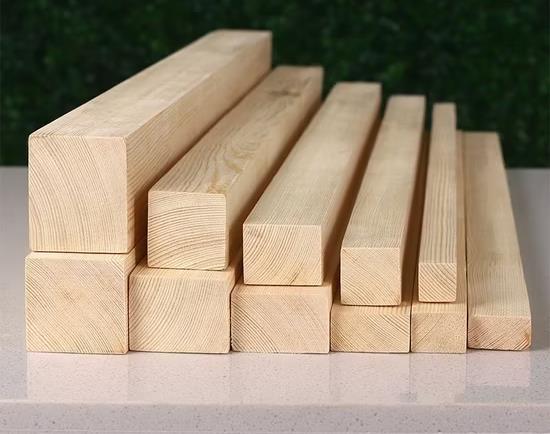
Creamy white to yellowish white
Density
0.25 to 0.35 g/cm³
Uses
Crate making, handicrafts, light objects, models and prototypes, pulp and light plywood.
Grain
Generally straight
Conservation Passport
- CITES
- Not listed
- BRAZILIAN RED LIST
- Not on the official list
- LEGISLATION
- Not on the official list of threatened species: harvesting of native trees only with an approved PMFS or a clearing authorization from the environmental agency, and transport with a DOF (Sinaflor).
About the species
Embaúba (Cecropia pachystachya) is a tree native to tropical America, belonging to the family Urticaceae (formerly classified as Cecropiaceae).
It is a very common species in secondary forests and regenerating areas, considered a pioneer and essential to the recovery of degraded ecosystems.
It also provides food and shelter for many wildlife species.
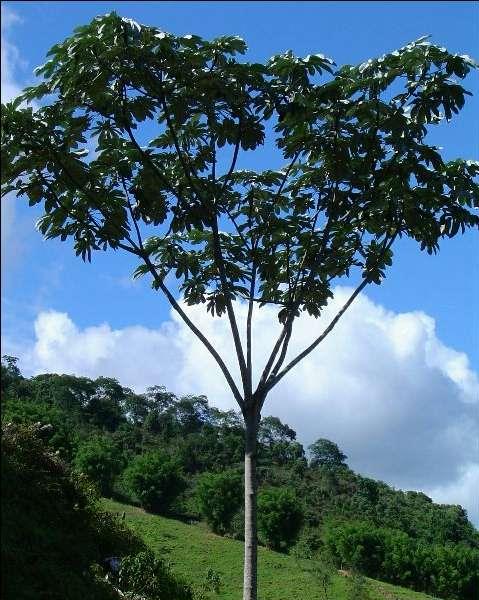
It is easily recognized by its large, palmate leaves, whitish on the underside.
The genus Cecropia includes several pioneer species common in the tropical forests of the Americas.
Embaúba has several common names in different regions. The name “árvore-da-preguiça” (sloth tree) comes from the fact that sloths often use its branches and leaves for shelter and food.
- Common names
Historical and cultural significance
– Embaúba has ecological, cultural and medicinal importance. In folk medicine, it is used to treat respiratory problems, control blood pressure and heal wounds.
– Indigenous peoples and traditional communities use the leaves and bark in medicinal preparations.
– It is vital to wildlife: its fruits feed birds, bats and many mammals.
Botanical classification
- DOMAIN
- Eukaryota
- KINGDOM
- Plantae
- DIVISION
- Magnoliophyta
- CLASS
- Magnoliopsida
- ORDER
- Rosales
- FAMILY
- Urticaceae
- GENUS
- Cecropia
- SPECIES
- Cecropia pachystachya
Natural distribution

- States of occurrence
- Ecology and habitat
– It grows mainly in open areas, forest clearings, degraded areas and forest edges.
– As a pioneer, it is one of the first species to colonize disturbed areas.
– Countries of occurrence: Brazil / Paraguay / Argentina / Bolivia / Peru
Tree morphology
- SIZE
- Embaúba trees reach heights of 10 to 20 meters.
- TRUNK
- Straight, cylindrical and often hollow.
- BARK
- Pale and relatively smooth.
- DBH
- 20 to 40 cm.
- LEAVES
- Large, palmate and deeply lobed, whitish on the underside.
- FRUIT
- Small and numerous, grouped in cylindrical structures, serving as food for many animals.
Maturity and harvest
- Timeline · from seed to senescence
Economic harvest · 8 to 15 years
economic harvest age
Full maturity · 15 to 25 years
peak wood quality
– Embaúba grows very fast, as is typical of pioneer species.
– Because of its fast growth, the species reaches usable dimensions in a few years.
– It is rarely harvested on a large scale for timber.
Wood characteristics
- HEARTWOOD
- Creamy white to yellowish white.
- SAPWOOD
- White to light cream, practically indistinguishable from the heartwood.
- TEXTURE
- Coarse and porous.
- GRAIN
- Generally straight.
- Working properties
– Workability: easy to saw and machine.
– Natural durability: low against fungi and insects.
– Embaúba wood has the typical characteristics of pioneer species.
– Density: Very light (0.25 to 0.35 g/cm³).
– Classification: It is a very light wood, with low mechanical strength and low commercial value. Because of these characteristics, it is classified as a common wood.
Wood uses
- Uses of the tree
– Restoration of degraded areas
– Reforestation
– Food for wildlife
– Traditional medicine
Conservation and legislation
Additional information
– Embaúba is of great ecological importance, being one of the main pioneer species in forest regeneration.
– There is also an important ecological relationship between embaúba and certain ant species, which live in its hollow trunk and help protect the plant against herbivores.
– It grows fast in open areas.
– It provides food and shelter for wildlife.