
- ATLAS OF WOODS
- Species Data Sheet
- ORIGIN: Atlantic Forest
Jacarandá-da-bahia
- Dalbergia nigra
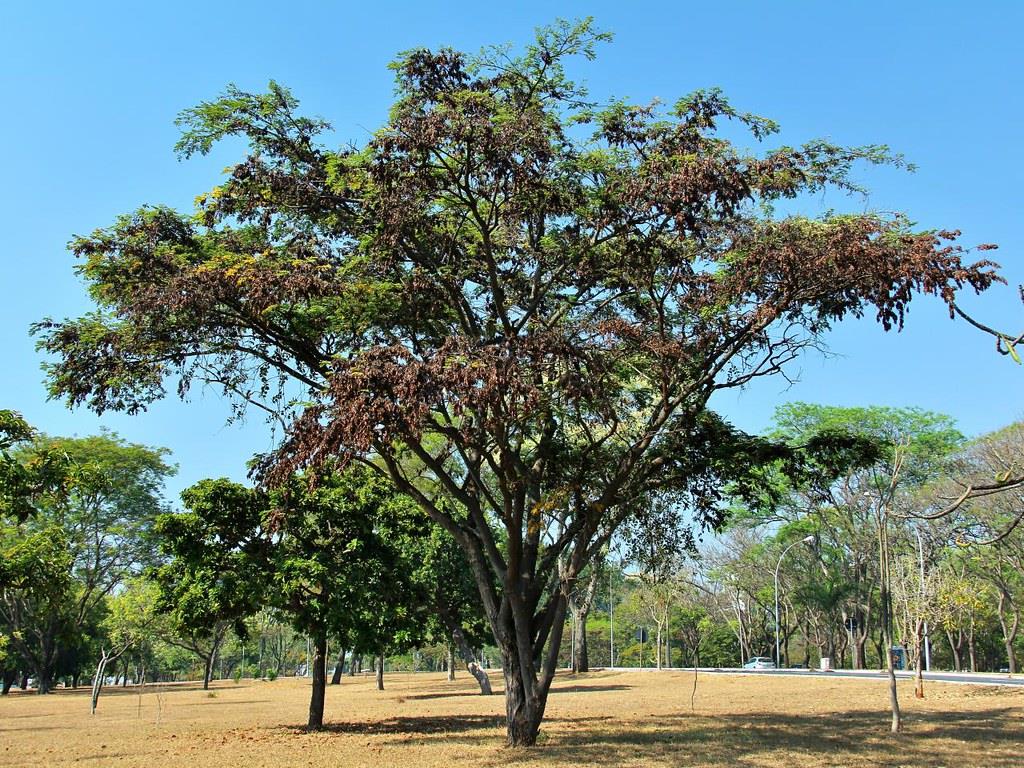
The jacarandá-da-bahia is a species native to the Atlantic Forest, prized for its dark, strong, high-quality wood, widely used in fine woodworking. Because of overexploitation and deforestation, the species is threatened and protected by specific environmental legislation.
Family
Fabaceae
Color
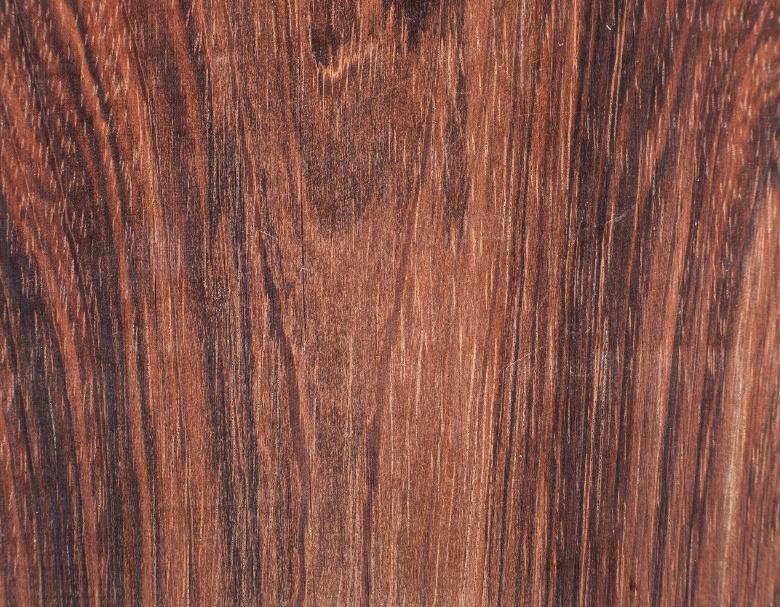
Brown to purplish
Figure
Dark streaks
Density
0.80 to 0.95 g/cm³
Uses
High-end furniture, musical instruments, decorative veneers, marquetry, sculptures and ornamental pieces.
Grain
Generally straight
Conservation Passport
- IUCN
- Vulnerable (VU) · assessed in 1998
- CITES
- Appendix I
- BRAZILIAN RED LIST
- Vulnerable (VU)
- LEGISLATION
- Threatened species (VU) on the official list and CITES App. I: felling of native trees is prohibited; only wood from licensed plantations or proven legal stock (DOF) may be used, and international commercial trade of wild origin is banned.
About the species
- Common names
Historical and cultural significance
– Its wood has always been highly prized for being dense, stable, decorative and acoustically outstanding, which led to intense historical exploitation.
– It is one of the best-known woods in the world and has high commercial and cultural value.
– The term “jacarandá” is used generically for several species.
– The jacarandá-da-bahia belongs to the Fabaceae family and is distinct from other species commonly called jacarandá.
– It is threatened with extinction, and its harvesting is controlled or prohibited in most cases.
Botanical classification
- DOMAIN
- Eukaryota
- KINGDOM
- Plantae
- DIVISION
- Magnoliophyta
- CLASS
- Magnoliopsida
- ORDER
- Fabales
- FAMILY
- Fabaceae
- GENUS
- Dalbergia
- SPECIES
- Dalbergia nigra
Natural distribution

- States of occurrence
- Ecology and habitat
– It does well on rolling to mountainous terrain; it prefers clayey to sandy-clay soils that are deep and well drained, with slightly acidic to neutral pH.
– It is a semi-heliophilous species, tolerating moderate shade but limited by low temperatures.
– Pure plantings in full sun should be avoided, as the plants grow in a disorderly way — which can result in short-trunked trees susceptible to borer attack.
– Originally, the jacarandá-da-bahia occurred in humid tropical forests at altitudes between 100 and 600 meters; today, its natural populations are greatly reduced because of deforestation and predatory exploitation.
– A hermaphrodite tree, pollinated mainly by bees and various small insects.
Tree morphology
- SIZE
- Medium to large, reaching 30 to 40 meters in height, with an imposing trunk.
- TRUNK
- Straight and cylindrical, with a relatively clear bole.
- BARK
- Grayish brown, with longitudinal fissures.
- CROWN
- Rounded and moderately dense.
- DBH
- Averages 30 to 50 cm, and can be larger in mature individuals.
- FRUIT
- Flattened pod containing winged seeds.
Maturity and harvest
- Timeline · from seed to senescence
Economic harvest · 30 to 40 years
economic harvest age, in theory
Full maturity · 50 to 70 years
peak wood quality, on average, which may vary with environmental and management conditions
- Theoretical projected yield of 100 to 150 m³/ha at 40 years · about 2 m³ of wood per adult tree
– The species grows slowly, and the highest-quality wood comes from adult trees.
– As a protected native species of the Atlantic Forest, felling is only allowed under authorized forest management or in legal plantations.
Wood characteristics
- HEARTWOOD
- Brown to purplish, with dark streaks; very durable and resistant to insects.
- SAPWOOD
- Pale and clearly demarcated.
- TEXTURE
- Medium to coarse.
- GRAIN
- Generally straight.
- References for average physical and mechanical properties
- JANKA HARDNESS
- 12,410 N
- MOR (MODULUS OF RUPTURE)
- 135 MPa
- MOE (MODULUS OF ELASTICITY)
- 13.93 GPa
- COMPRESSION PARALLEL TO GRAIN
- 67.2 MPa
- RADIAL SHRINKAGE
- 2.9%
- TANGENTIAL SHRINKAGE
- 4.6%
- VOLUMETRIC SHRINKAGE
- 8.5%
- T/R RATIO
- 1.6
- Working properties
– Luster: natural.
– Machining: good, though it may dull tools.
– Gluing: may require preparation because of extractives.
– Finishing and dimensional stability: excellent when properly dried.
– Natural durability and resistance to wood-destroying organisms: high.
– Permeability to preservative treatments: low.
– Density: Medium to high (0.80 to 0.95 g/cm³).
Wood uses
- Uses of the tree
Conservation and legislation
– Felling is prohibited except in exceptional cases with a specific environmental permit, and may only take place under an approved management plan with proven legal origin.
– It is listed in CITES Appendix I, the highest level of protection: international trade is virtually prohibited except under extremely restricted conditions — in practice, almost entirely prohibited.
– As with any wood or product, it must have a Forest Origin Document (DOF), an invoice and traceability.
Additional information
– The term “caviúna” is used commercially for similar woods and is not exclusive to the jacarandá-da-bahia.
– No reliable information was found on existing jacarandá-da-bahia plantations.
– It has been, and still is, very rarely grown commercially.
– It shows slow germination and a low survival rate in plantations.
– Most of its occurrence corresponds to the original Atlantic Forest, not to organized plantations.
– Today, the focus of organizations in the sector is more on preserving and restoring fragments of native vegetation than on growing it for production: afforestation and reforestation projects are being promoted by environmental institutions.