
- ATLAS OF WOODS
- Species Data Sheet
- ORIGIN: Atlantic Forest
Peroba-rosa
- Aspidosperma polyneuron
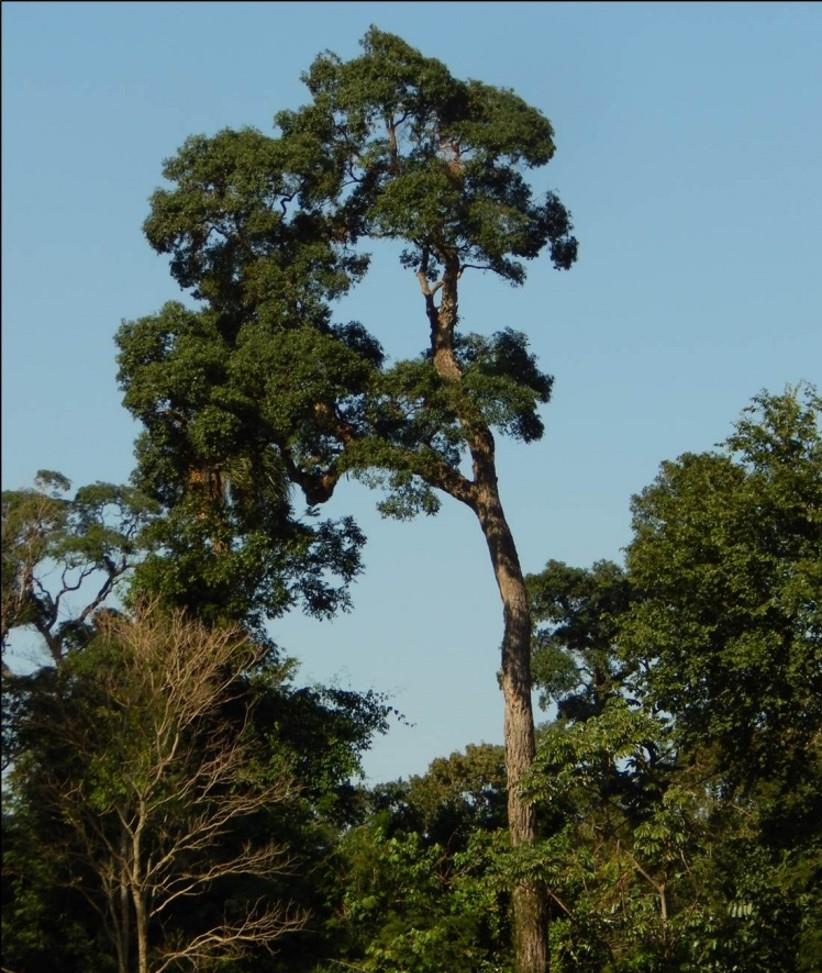
Peroba-rosa is a medium- to large-sized tree species native to the Atlantic Forest, whose wood is valued for its strength, durability and characteristic color. Its strong, durable, pinkish wood is widely used in structures, flooring and fine woodworking.
Family
Apocynaceae
Color
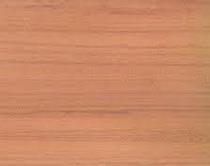
Pinkish to pinkish-red heartwood
Figure
Striking veining
Density
0.65 to 0.85 g/cm³
Uses
Roofing, beams, railroad ties, crossarms, panels, cladding and high-end furniture.
Grain
Straight to slightly cross-grained
Conservation Passport
- IUCN
- Endangered (EN) · assessed in 1998
- CITES
- Not listed
- BRAZILIAN RED LIST
- Not on the official list
- LEGISLATION
- Not on the official list of threatened species: harvesting of native specimens only with an approved PMFS or a clearing authorization from the environmental agency, and transport with DOF (Sinaflor).
About the species
Peroba-rosa (Aspidosperma polyneuron) is one of the most emblematic trees of the Atlantic Forest and holds great historical, economic and cultural relevance in Brazil, especially in the Southeast and South regions.
Regarded as a noble structural wood, it became a symbol of the agricultural and urban settlement of the interior of São Paulo and Paraná.
It is currently protected by environmental legislation and listed as threatened due to overexploitation and habitat loss.
- Common names
Historical and cultural significance
– Between the late 19th century and the mid-20th century, peroba-rosa was widely exploited during the settlement of the interior of states such as São Paulo, Paraná, Minas Gerais and Mato Grosso do Sul.
– Its strong, durable wood was essential for building houses, churches and warehouses; railroad ties; bridges and rural structures; and high-quality furniture.
– In the colonization of Paraná, peroba-rosa became a symbol of forest abundance: gigantic trees were common and left their mark on the region’s collective memory.
– It is part of the national architectural heritage, as many mansions, historic farms and public buildings in Brazil still preserve floors, doors and windows, ceilings and staircases.
Botanical classification
- DOMAIN
- Eukaryota
- KINGDOM
- Plantae
- DIVISION
- Magnoliophyta
- CLASS
- Magnoliopsida
- ORDER
- Gentianales
- FAMILY
- Apocynaceae
- GENUS
- Aspidosperma
- SPECIES
- Aspidosperma polyneuron
Natural distribution

- States of occurrence
- Ecology and habitat
– Also occurs naturally in: Argentina / Paraguay / Bolivia
– Habitat: Semideciduous seasonal forests; Fertile, deep soils; Regions with tropical and subtropical climates; Historically abundant on fertile soils (terra roxa), it is now scarce in natural forests; The species is considered an icon of Brazil’s forest wealth and a symbol of the need for conservation.
Tree morphology
- SIZE
-
The peroba-rosa tree is medium- to large-sized, able to reach 20 to 40 meters in height.
Growth: Markedly vertical, typical of dense-forest species.
Fruits: Woody follicles with winged seeds.
- TRUNK
-
Cylindrical, straight or slightly crooked, with a straight bole up to 30 m long, often free of branches at the base.
Form: Emergent tree, with a high crown and little branching in the lower parts.
Root system: Taproot type (deep main root).
Latex: Produces latex (a characteristic of the family Apocynaceae).
- BARK
- Thick, grayish brown, fissured.
- CROWN
- Elongated to irregular in shape, in a high position (high crown).
- DBH
- Ranging from 50 to 100 cm, and can exceed 150 cm in the wild.
- LEAVES
- Simple, opposite; the leathery leaves reduce water loss, indicating adaptation to dry periods.
Maturity and harvest
- Timeline · from seed to senescence
Economic harvest · 30 to 45 years
economic harvest age, on average, which may vary with environmental conditions
Full maturity · 50 to 80 years
the wood generally reaches its full quality between 50 and 80 years
– Peroba-rosa shows medium to slow growth.
– Because of its slower growth, it is seldom chosen for commercial plantations.
– Longevity: Over 200 years · it is highly long-lived: it can live more than 200 years
Wood characteristics
- HEARTWOOD
- Color: pinkish to pinkish-red heartwood.
- SAPWOOD
- Yellowish.
- TEXTURE
- Fine.
- GRAIN
- Straight to slightly cross-grained.
- Properties
- MOR (MODULUS OF RUPTURE)
- 90 to 120 MPa
- MOE (MODULUS OF ELASTICITY)
- 11 to 13 GPa
- COMPRESSION PARALLEL TO GRAIN
- 50 to 55 MPa
- RADIAL SHRINKAGE
- 4.0%
- TANGENTIAL SHRINKAGE
- 7.8%
- VOLUMETRIC SHRINKAGE
- 11 to 15%
- Working properties
– Odor: faint.
– Permeability: low (difficult to treat with preservative).
– Dimensional stability: good after drying.
– Structural performance: intermediate to good, suitable for traditional building construction.
– Resistance to termites and decay fungi: good.
– Resistance to weathering and wear: good.
– Planing and sanding: excellent finishes.
– Gluing: easy.
– Drying: relatively slow, with a moderate risk of warping and cracking.
– Workability: good, although it may cause moderate tool wear.
– Peroba-rosa wood is highly prized for its pinkish tone and striking veining.
– Density: Medium to high (0.65 to 0.85 g/cm³).
– Porosity: Diffuse, with medium to large veins visible to the naked eye.
– Volumetric shrinkage (2nd value): 13.1%
Wood uses
- Uses of the tree
– Atlantic Forest reforestation
– Urban tree planting (uncommon)
– Restoration of degraded areas
– Important for biodiversity conservation
Conservation and legislation
– Subject to the rules of the Brazilian Forest Code.
– In the Atlantic Forest, Law No. 11.428/2006 applies.
– Cutting permitted only in legal plantations and under authorized forest management.
– A species of high value for genetic conservation.
Additional information
– Peroba-rosa has high ecological importance, contributing to forest structure and biodiversity conservation.
– Its bending and compressive strength are at high levels for tropical woods, indicating that peroba-rosa is suitable for moderately demanding structural applications.
– Its modulus of elasticity (stiffness) is moderate to high, suggesting good stiffness for structural design, although it does not match woods of extreme stiffness.
– It is a naturally durable wood resistant to biological attack, but not recommended for permanent outdoor use without protection.
– Its pinkish tone and uniform texture make it regarded as one of the most beautiful woods in Brazil.
– Its advantages include: excellent mechanical strength for structural use; good density and hardness, which favor surface durability and provide abrasion resistance; reasonable dimensional stability, with moderate shrinkage; a prized aesthetic appearance.
– Its likely limitations: natural durability is not as high as that of some of the best tropical woods, requiring treatment or protection; the density and possible cross grain require good tools and techniques; the high weight can be a disadvantage in structures where self-weight is critical or in heavy transport; availability and cost may be restricted due to the conservation of the species.