
- ATLAS OF WOODS
- Species Data Sheet
- ORIGIN: Amazon · Cerrado · Atlantic Forest · Pantanal · Caatinga woodland
Jatobá
- Hymenaea courbaril
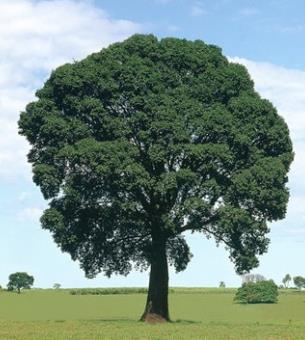
Jatobá is a large tree species widely distributed across the tropical regions of the Americas, whose wood stands out for its high hardness, mechanical strength and durability. Its wood is very hard, heavy and strong, with a reddish tone, and is widely used in flooring and beams.
Family
Fabaceae
Color
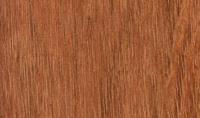
Reddish brown, darkening over time
Density
0.80 to 1.00 g/cm³ (approximately)
Uses
High-traffic flooring, beams, pillars and heavy construction, railroad ties, bridges and hydraulic works, solid-wood furniture, decks, stairs, heavy turning and tool handles.
Grain
Generally interlocked
Conservation Passport
- IUCN
- Least Concern (LC) · assessed in 2012
- CITES
- Not listed
- BRAZILIAN RED LIST
- Not on the official list
- LEGISLATION
- Not on the official list of threatened species: harvesting of native specimens only with an approved PMFS or a clearing authorization from the environmental agency, and transport with DOF (Sinaflor).
About the species
Jatobá (Hymenaea courbaril) has high economic value thanks to the quality of its wood, and is widely used in structural applications and flooring production.
Beyond timber, it has food and medicinal importance, with its fruits used in the form of flour.
- Common names
Historical and cultural significance
– Jatobá is traditionally used in heavy construction and flooring, and is recognized for its durability and strength.
– Used by Indigenous peoples for food (flour from the fruit) and natural medicine.
– The tree’s resin, known as copal, has traditional uses as a natural varnish.
– It is a symbol of robustness and durability in Brazilian timber culture.
Botanical classification
- DOMAIN
- Eukaryota
- KINGDOM
- Plantae
- DIVISION
- Magnoliophyta
- CLASS
- Magnoliopsida
- ORDER
- Fabales
- FAMILY
- Fabaceae
- GENUS
- Hymenaea
- SPECIES
- Hymenaea courbaril L.
Natural distribution

- States of occurrence
- Ecology and habitat
– Trees: semi-heliophilous and semideciduous.
– Habitat: clayey or sandy, well-drained soils; occurs both in dense forests and in open formations.
– Tolerance: high resistance to drought and to relatively poor soils.
– Climate: humid or seasonal tropical, with tolerance of dry periods.
– Biomes in Brazil: Amazon / Cerrado / Atlantic Forest / Pantanal / Caatinga woodland
– Other countries: From Mexico to southern Brazil, including Central America and the Caribbean.
Tree morphology
- SIZE
-
Large tree, able to reach 25 to 40 meters in height.
Bole: Thick, cylindrical, usually long and clean.
Root: Deep and robust. Forms monumental, very long-lived trees.
- BARK
- Thick, grayish brown, fissured.
- CROWN
- Broad, dense and rounded.
- DBH
- 60 to 120 cm, but as a native tree its diameter can exceed 2 m.
- LEAVES
- Bifoliolate compound, leathery.
- FRUIT
- Hard woody pod with edible floury pulp.
Maturity and harvest
- Timeline · from seed to senescence
Economic harvest · 30 to 50 years
economic harvest age, on average, which may vary with environmental conditions
Full maturity · After 40 years
full wood maturity generally occurs after 40 years
– Jatobá growth is moderate.
– In natural forests, commercial trees are usually over 70 years old.
– Management: requires wide spacing and long cycles.
– Longevity: 150 to 200 years · it has good longevity, able to live 150 to 200 years
Wood characteristics
- HEARTWOOD
- Reddish brown, darkening over time.
- SAPWOOD
- Light, clearly distinct.
- TEXTURE
- Medium to coarse.
- GRAIN
- Generally interlocked.
- Working properties
– Natural luster: low to moderate, which with finishing can become medium to high.
– Natural durability without ground contact: very high.
– Natural durability in ground contact: moderate.
– Stability: good, for a heavy wood.
– Drying: slow, requiring control to avoid cracking.
– Workability: difficult, requiring robust tools.
– Susceptible to marine borers.
– Can be planed, glued, screwed and nailed.
– Density: High — approximately 0.80 to 1.00 g/cm³.
Wood uses
- Uses of the tree
– Reforestation and restoration of degraded areas
– Shade
– Ecological balance
– Uses of tree products: Fruit: produces “jatobá flour,” rich in fiber and nutrients, used in traditional diets and in preparing regional drinks and recipes; Bark and resin: used in folk medicine — bark tea: respiratory and digestive use; resin (“copal”): natural varnish, with traditional therapeutic applications.
Conservation and legislation
– Harvesting must follow sustainable forest management.
– Important in ecological restoration programs.
– Not listed in CITES Appendix I, but subject to Brazilian environmental legislation.
– Good practices: sustainable management; long harvest cycles; forest certification (FSC / CERFLOR).
Additional information
– Jatobá is one of the most important timber trees of the tropical Americas, standing out for its extreme strength, natural durability and broad structural application.
– It adapts well to different environmental conditions, making it relevant both economically and ecologically.
– It is a very long-lived species.
– Its wood is recommended for uses where strength and service life are priorities.
– Pollination is carried out by bees and bats.
– Despite its relatively slow growth, its wood has high technical and commercial value, and is a benchmark among Brazil’s heavy noble woods.