
- ATLAS OF WOODS
- Species Data Sheet
- ORIGIN: Atlantic Forest · Cerrado · Caatinga · Pantanal
Angico
- Anadenanthera spp.
Angico is the name given to a group of native trees widely distributed across South America, known for their strong, durable wood. It is of great economic importance and is used in building construction, charcoal production and the timber industry.
Family
Fabaceae
Color
Reddish brown to dark
Density
0.80 to 1.05 g/cm³
Uses
Building construction, rural structures, beams and columns, flooring, railroad ties and charcoal production.
Grain
Generally interlocked
Conservation Passport
- IUCN
- A. colubrina: Least Concern (LC) · assessed in 2020
- CITES
- Not listed
- BRAZILIAN RED LIST
- Not on the official list
- LEGISLATION
- Not on the official list of threatened species: native trees may only be harvested under an approved PMFS or a vegetation-removal authorization from the environmental agency, and transport requires a DOF (Sinaflor).

About the species
The name angico (Anadenanthera spp.) identifies a set of tree species belonging to the Fabaceae family.
These species stand out for the high strength of their wood and for chemical compounds used in traditional medicine.
They are widely distributed across different Brazilian biomes.
The main species is Anadenanthera colubrina, the subject of this entry.
Species: Anadenanthera colubrina and Anadenanthera peregrina
The genus Anadenanthera includes few tree species, but they are of great ecological and economic importance.
The selected species has many regional names in Brazil and neighboring countries. The variety of names reflects the species’ wide geographic distribution.
- Common names
Historical and cultural significance
– Angico has great historical and cultural importance in Brazil.
– Traditionally, it is used for extracting tannins from the bark, making natural medicines, rural construction and charcoal production.
– Some species of the genus are also used in traditional Indigenous practices.
Botanical classification
- DOMAIN
- Eukaryota
- KINGDOM
- Plantae
- DIVISION
- Magnoliophyta
- CLASS
- Magnoliopsida
- ORDER
- Fabales
- FAMILY
- Fabaceae
- GENUS
- Anadenanthera
Natural distribution

- States of occurrence
- Ecology and habitat
– It grows in well-drained soils, in tropical and subtropical climates, in open areas and in seasonal forests.
– Countries of occurrence (South America): Brazil / Argentina / Paraguay / Bolivia
– Biomes in Brazil: Atlantic Forest / Cerrado / Caatinga / Pantanal
Tree morphology
- SIZE
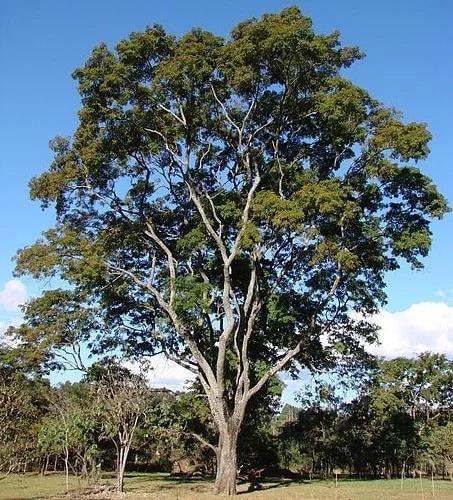
- Medium to large, with trees 10 to 25 m tall.
- TRUNK
- Straight and cylindrical.
- BARK
- Thick, dark and rich in tannins.
- CROWN
- Broad and irregular.
- DBH
- 40 to 80 cm.
- LEAVES
- Bipinnately compound.
- FRUIT
- Flattened pods containing hard seeds.
Maturity and harvest
- Timeline · from seed to senescence
Economic harvest · 30 to 50 years
economic harvest age
Full maturity · 40 to 60 years
peak quality
– It grows at a moderate rate.
– Forest management is based on a minimum cutting diameter, generally between 40 and 60 cm DBH.
Wood characteristics
- HEARTWOOD
- Reddish brown to dark.
- SAPWOOD
- Pale yellow to yellowish white, narrow to moderately wide, clearly distinct from the heartwood.
- TEXTURE
- Medium.
- GRAIN
- Generally interlocked.
- Working properties
– Workability: moderate.
– Resistance to fungi and insects: high.
– Structural stability: good.
– Mechanical strength: high.
– Natural durability: high.
– Density: High (0.80 to 1.05 g/cm³).
– Classification: It is classified as a semi-noble wood because of its high strength and durability, and is widely used in structural applications; In some cases, it may be classified as a regional noble wood because of its high density and durability.
Wood uses
- Uses of the tree
– Tannin extraction
– Traditional medicinal use
– Reforestation
– Restoration of degraded areas
Conservation and legislation
– Its harvesting must follow Brazilian environmental legislation, sustainable forest management plans and regional logging controls.
– Reforestation and ecological restoration programs have encouraged planting of the species.
Additional information
– Angico is of great economic and ecological importance.
– It stands out for its high mechanical strength, excellent natural durability, good acceptance for structures, fence posts and flooring, and production of useful chemical compounds (tannins).
– It is a versatile species, with both industrial and environmental applications.