
- ATLAS OF WOODS
- Species Data Sheet
- ORIGIN: Mixed Ombrophilous Forest (Araucaria forest)
Imbuia
- Ocotea porosa
Imbuia is a tree species native to southern Brazil whose wood is highly valued for its dimensional stability, strength and decorative appearance, and is widely used in furniture and fine finishes.
Family
Lauraceae
Color
Brown, ranging from golden to dark brown
Figure
Striking decorative veining
Density
0.65 to 0.85 g/cm³
Uses
High-end furniture, interior cladding, decorative panels and sculptures.
Grain
Irregular or wavy
Conservation Passport
- IUCN
- Vulnerable (VU) · assessed in 1998
- CITES
- Not listed
- BRAZILIAN RED LIST
- Endangered (EN)
- LEGISLATION
- Threatened species (EN) on the official list: cutting, transport and trade of native specimens prohibited; exceptions only for licensed plantations and authorized research.

About the species
Imbuia (Ocotea porosa) is a species native to the Araucaria forest of southern Brazil that produces wood of high commercial value, notable for its stability and distinctive look.
Its wood is one of the noblest in Brazil, and it is regarded as one of the most traditional species in Brazilian woodworking.
Important for wildlife, with seeds dispersed by birds.
- Common names
Historical and cultural significance
– Imbuia had great economic importance in the 19th and 20th centuries, especially in southern Brazil, where it was widely used in fine furniture and high-end woodworking.
– Between the 19th and 20th centuries, it was one of the mainstays of the timber economy of Paraná and Santa Catarina, widely used in fine furniture and decorative panels.
– It became a symbol of traditional Brazilian carpentry.
– Intense exploitation led to a significant reduction in its natural populations.
Botanical classification
- DOMAIN
- Eukaryota
- KINGDOM
- Plantae
- DIVISION
- Magnoliophyta
- CLASS
- Magnoliopsida
- ORDER
- Laurales
- FAMILY
- Lauraceae
- GENUS
- Ocotea
- SPECIES
- Ocotea porosa
Natural distribution

- States of occurrence
- Ecology and habitat
– Forms stands known as “imbuiais” in mature forests.
– Prefers deep, fertile, well-drained soils.
– Also present in: Paraguay / Argentina (northeast)
Tree morphology
- SIZE
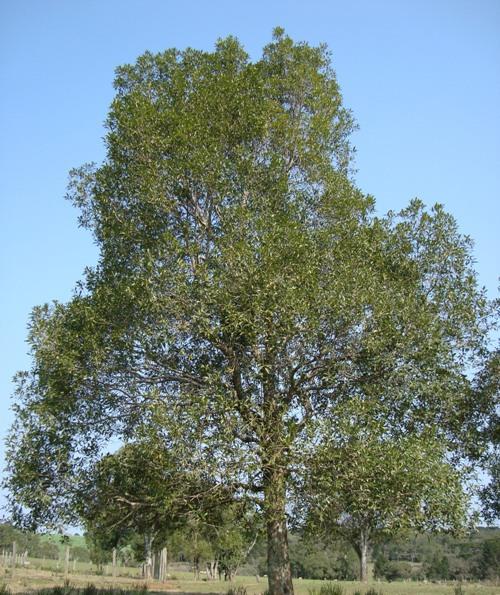
- Medium- to large-sized tree, able to reach 20 to 40 meters in height.
- TRUNK
- Straight, cylindrical, with a long bole.
- BARK
- Dark brown, thick and fissured, with a characteristic aroma.
- CROWN
- Tall, rounded and relatively dense.
- DBH
- Large DBH, usually between 60 cm and 1.2 m, reaching 1.5 m.
- LEAVES
- Simple, leathery, dark green, aromatic when crushed.
- FRUIT
- Dark berry, dispersed by birds.
Maturity and harvest
- Timeline · from seed to senescence
Economic harvest · 35 to 40 years: general sawmill use. 40 to 50 years: higher-quality woodworking. 50 years or more: high-end products.
Full maturity · 60 years or more
the wood generally reaches its full quality after 60 years or more, which may vary with environmental conditions
Wood characteristics
- HEARTWOOD
- Brown, ranging from golden to dark brown, often with striking decorative veining.
- SAPWOOD
- Light, uniform and less resistant.
- TEXTURE
- Fine to medium.
- GRAIN
- Irregular or wavy.
- Mechanical properties (average values)
- JANKA HARDNESS
- 4,300 N
- MOR (MODULUS OF RUPTURE)
- 85 MPa
- MOE (MODULUS OF ELASTICITY)
- 9.6 GPa
- COMPRESSION PARALLEL TO GRAIN
- 47 MPa
- RADIAL SHRINKAGE
- 3.0%
- TANGENTIAL SHRINKAGE
- 6.4%
- VOLUMETRIC SHRINKAGE
- 9.5%
- T/R RATIO
- 2.1
- Working properties
– Natural durability: high.
– Stability: very good.
– Workability: very good, with excellent sanding and polishing.
– Odor: characteristic, pleasant and spicy.
– Natural durability: good.
– Resistance to wood-destroying organisms: good.
– A wood considered stable and highly decorative.
– Density: Medium to high (0.65 to 0.85 g/cm³).
– Hardness: Medium to high.
Wood uses
- Uses of the tree
– Ornamental species
– Conservation and restoration of the Araucaria forest
Conservation and legislation
– It is currently protected by Brazilian environmental legislation, as cutting in native forests is restricted and subject to environmental regulation.
– It appears on official lists of threatened species.
– It is part of conservation and reforestation programs.
– Sustainable management and forest restoration are essential to its preservation.