
- ATLAS OF WOODS
- Species Data Sheet
- ORIGIN: Atlantic Forest
Pau-brasil
- Paubrasilia echinata
Pau-brasil is a species native to the Atlantic Forest, historically exploited for the extraction of dye and quality timber. A national symbol, the species is threatened by predatory exploitation and habitat loss, and is currently protected by environmental legislation.

Family
Fabaceae
Color
Deep red, darkening over time
Density
0.85 to 1.10 g/cm³
Uses
String instrument bows, decorative veneers, marquetry, turned pieces, high-value objects, dye and luxury objects.
Grain
Straight or occasionally interlocked
Conservation Passport
- IUCN
- Endangered (EN) · assessed in 1998
- CITES
- Appendix II
- BRAZILIAN RED LIST
- Endangered (EN)
- LEGISLATION
- Threatened species (EN) on the official list: cutting, transport and trade of native specimens prohibited (including for bows); exceptions only for licensed plantations and authorized research. Commercial export of wild timber has a zero quota under CITES.
Pau-brasil in three views
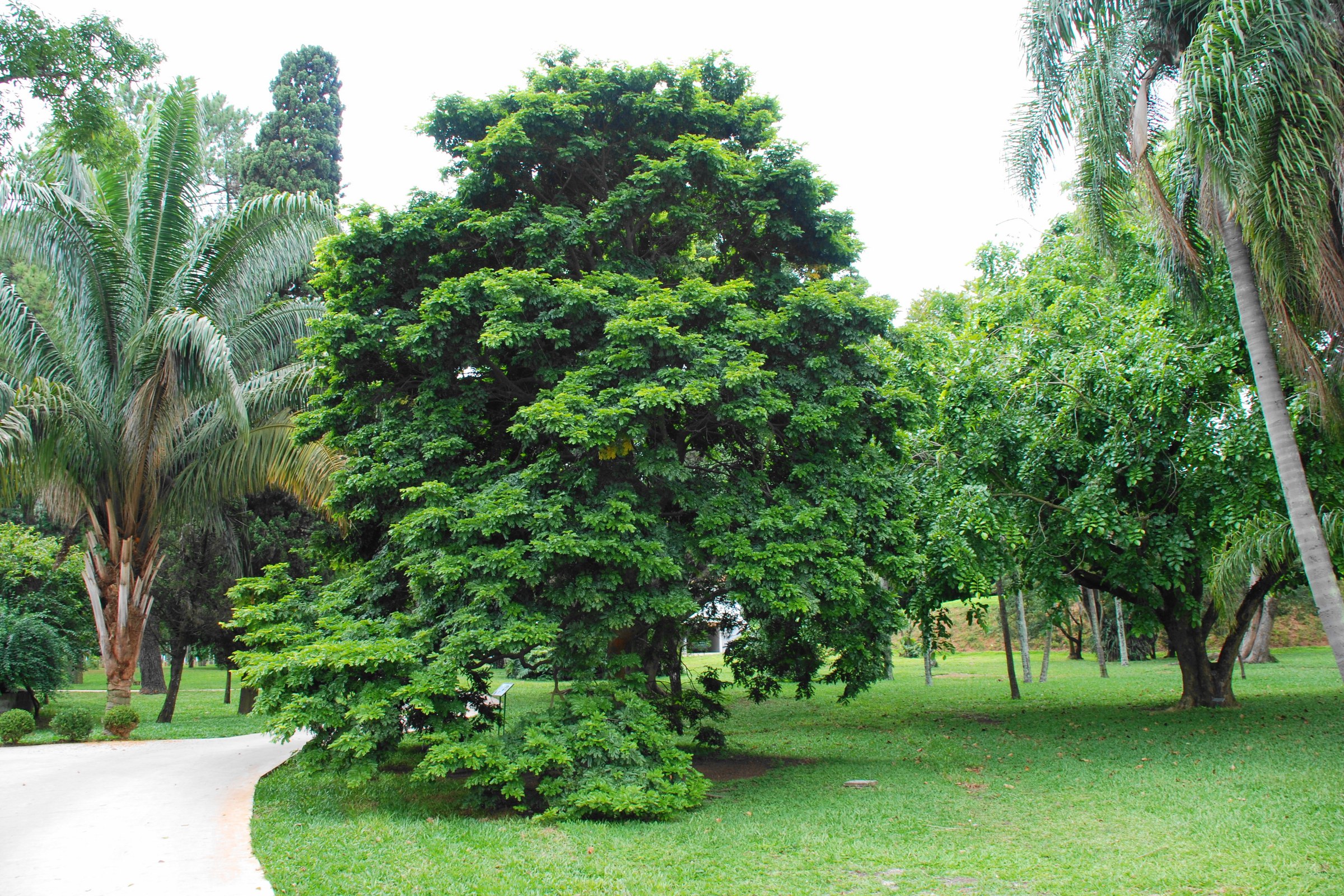
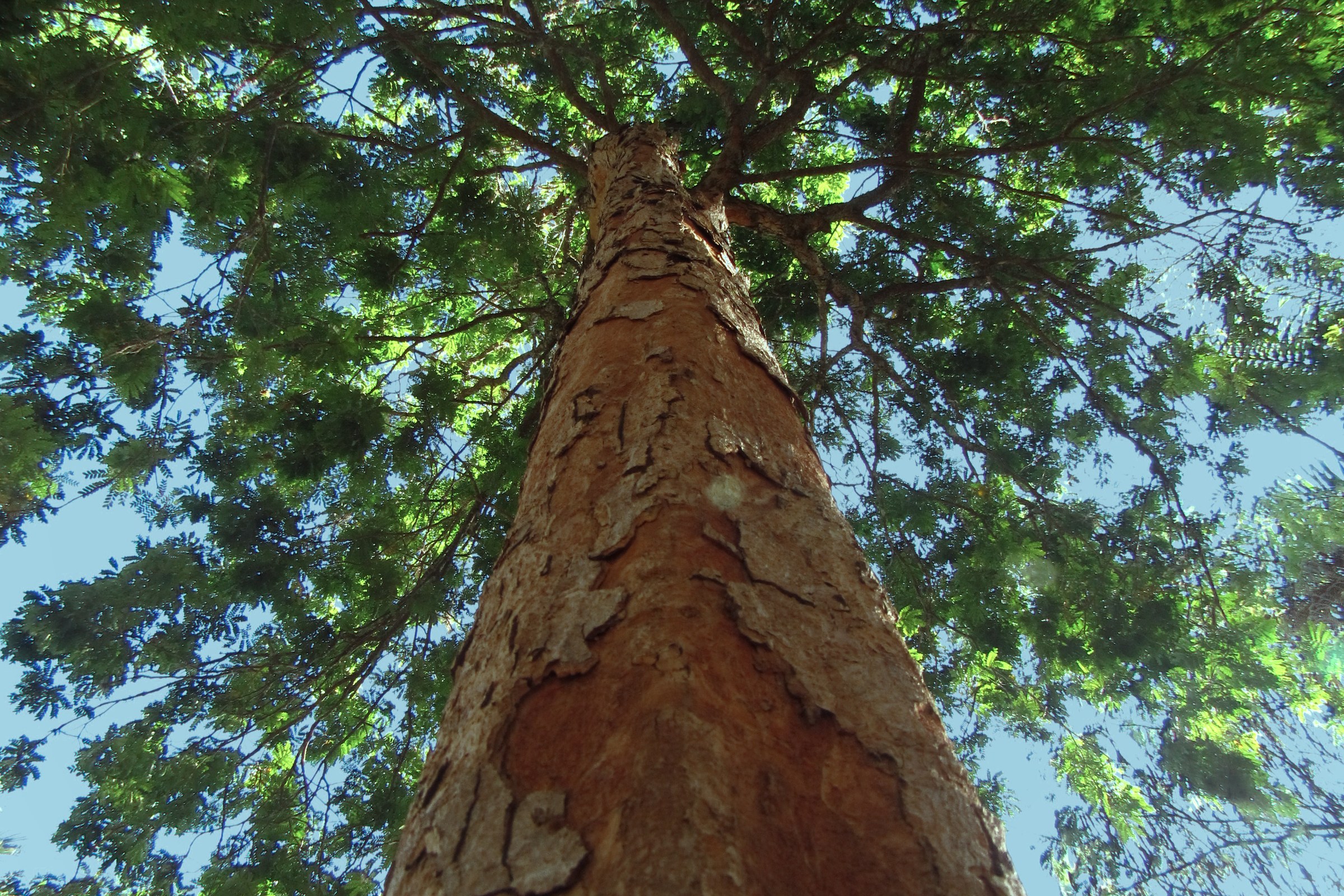
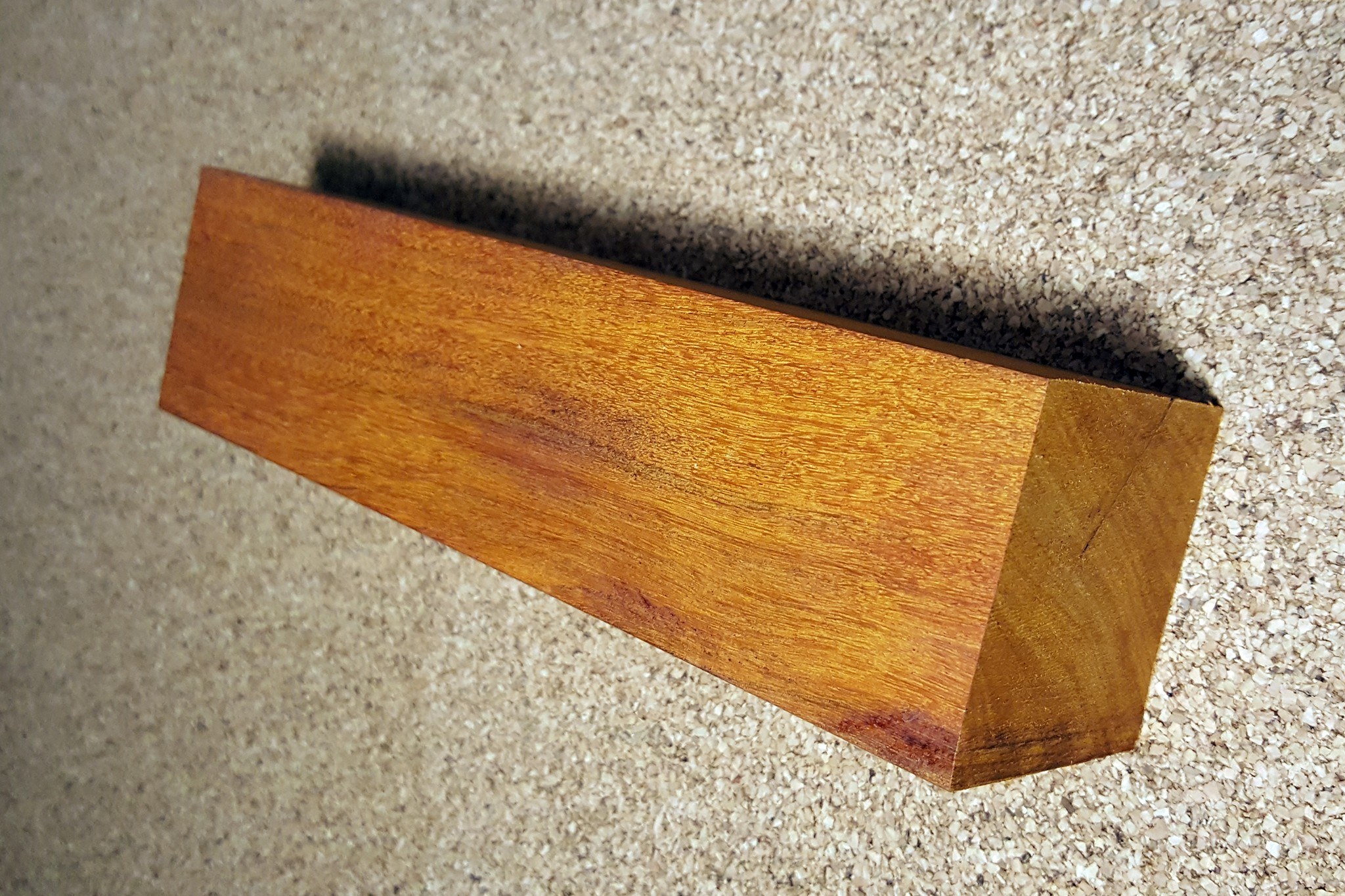
Photos: I · “Caesalpinia echinata Tree 3”, by mauroguanandi (CC BY 2.0) · II · “Árvore pau-brasil (Paubrasilia echinata)”, by Jani Pereira (CC BY-SA 4.0) · III · “Brazilwood Paubrasilia echinata square blank”, by Fopseh (CC BY-SA 4.0) — via Wikimedia Commons; cropped for the plate.
About the species
- Common names
Historical and cultural significance
– Since the 16th century, it was intensively exploited by Portuguese colonizers for its red wood rich in brazilin, a pigment used as a high-value textile dye.
– It was the first economically significant product exploited in Brazil’s colonial period.
– Culturally, it became a national symbol and a historic species of the Atlantic Forest.
– Its wood is also famous for its excellence in violin bow making, and is considered the best in the world for this purpose.
– Brazil’s national tree, it is depicted in the emblem of the National Historic and Artistic Heritage Institute (IPHAN).
Botanical classification
- DOMAIN
- Eukaryota
- KINGDOM
- Plantae
- DIVISION
- Magnoliophyta
- CLASS
- Magnoliopsida
- ORDER
- Fabales
- FAMILY
- Fabaceae
- GENUS
- Paubrasilia
- SPECIES
- Paubrasilia echinata
Natural distribution

- States of occurrence
- Ecology and habitat
– Natural records also exist in: Paraíba / Sergipe
– Typical habitat: Dense ombrophilous and seasonal forests of the Atlantic Forest; Areas with well-drained soils; Regions with a humid tropical climate; Land near the coast, generally at low altitude.
Tree morphology
- SIZE
-
Medium-sized tree, with height ranging from 10 to 20 meters.
Branches: Young branches bear small thorns.
- TRUNK
- Straight, cylindrical, with medium branching.
- BARK
- Thick, grayish and fissured.
- CROWN
- Irregular to rounded, relatively open.
- DBH
- Reaches, on average, 40 to 70 centimeters.
- LEAVES
- Bipinnately compound, with numerous small leaflets.
- FRUIT
-
Woody, flattened, spiny pod.
Propagation: Predominantly by hard seeds, few per fruit.
Maturity and harvest
- Timeline · from seed to senescence
Economic harvest · 40 to 50 years
economic harvest age, on average, varying with environmental conditions and management
Full maturity · 35 to 50 years
the wood may reach its full quality after 35 to 50 years
– Growth rate is slow to moderate.
– Cutting native populations is prohibited; it is permitted only in legally authorized plantations.
– Maturation cycle: 25 to 30 years
– Longevity: Over 200 years · it is a long-lived species, able to live for more than 200 years
Wood characteristics
- HEARTWOOD
- Deep red in color, darkening over time as a result of the presence of brazilin.
- SAPWOOD
- Light yellow tone.
- TEXTURE
- Fine and uniform, with good natural luster.
- GRAIN
- Straight or occasionally interlocked.
- Average physical properties
- JANKA HARDNESS
- 12,550 N · extremely hard wood
- MOR (MODULUS OF RUPTURE)
- MOR and MOE values indicate good static bending strength.
- COMPRESSION PARALLEL TO GRAIN
- 74 MPa · moderate compressive strength
- RADIAL SHRINKAGE
- 4.7%
- Working properties
– Machining: despite its high density, it usually shows good workability; cross grain may cause tear-out.
– Gluing and finishing: extractives may interfere, so proper surface preparation is recommended.
– Extremely hard, heavy and strong.
– Shows variable resistance to wood-boring insects and may require additional protection under certain conditions.
– Difficult to saw and work because of its hardness; when polished, it takes an excellent finish.
– Special property: excellent acoustic elasticity.
– Pau-brasil wood is dense and deep red, darkening over time due to the oxidation of brazilin.
– Note · Brazilin: A chemical compound extracted from the heartwood, it is a phenol — C₁₆H₁₄O₅ — with an –OH group bonded to aromatic rings.
– Density: Range of 0.85 to 1.10 g/cm³.
– Drying: Because it is very dense, it carries a higher risk of collapse, cracking and internal stresses.
– Mechanical strength: High.
– Stability in service: Good.
Wood uses
- Uses of the tree
– Atlantic Forest reforestation projects
– Urban areas (landscaping)
– Environmental restoration
– Attracting wildlife (pollinators)
Conservation and legislation
– Pau-brasil is considered an endangered species and appears on international conservation lists.
– Exploitation is highly restricted, permitted only in controlled plantations with legal traceability.
– There are reforestation and preservation projects led by institutions such as the Instituto Pau-Brasil, universities and NGOs.
– Although rarely found in the wild, it can be successfully cultivated in nurseries and botanical gardens.
– Since 2006, Espírito Santo has planted more than 350,000 pau-brasil seedlings in agroforestry systems, especially to meet the demand for musical instrument bows.